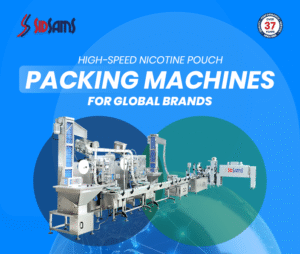


The nicotine pouch industry is expanding rapidly across global markets such as the USA, Sweden, Germany, UK, Poland and Canada. As production demand increases, manufacturers are searching for reliable nicotine pouch packing machines that can deliver speed, accuracy and consistent packing quality.
One of the most common questions buyers ask when planning a production line is whether to choose an automatic nicotine pouch packing machine or a semi-automatic nicotine pouch packing machine. Understanding the difference between these two systems helps manufacturers select the right solution based on production capacity, investment budget and long-term growth plans.
What is an Automatic Nicotine Pouch Packing Machine?
An automatic nicotine pouch packing machine is a fully automated system designed for high-speed industrial production. These machines perform the entire packaging process including pouch filling, weighing and sealing with minimal human involvement.
Key advantages include:
- High-speed production output
- Consistent pouch weight and filling accuracy
- Reduced labor dependency
- Lower production errors
- Continuous large-scale manufacturing
Automatic machines are typically preferred by large nicotine pouch manufacturers, private label producers and export-oriented companies that require high production volumes and consistent product quality.
What is a Semi-Automatic Nicotine Pouch Packing Machine?
A semi-automatic nicotine pouch packing machine combines manual operation with automated functions such as filling or sealing. Operators assist in certain stages of the packaging process while the machine performs precision tasks.
Key benefits include:
- Lower initial investment cost
- Flexible production setup
- Suitable for small to medium production volumes
- Easy operation and maintenance
- Ideal for new manufacturers entering the market
Semi-automatic machines are often used by startups, small nicotine pouch brands and companies testing new product lines before moving to fully automated production.
Automatic vs Semi-Automatic Machines – Key Differences
When comparing automatic and semi-automatic nicotine pouch packing machines, the main differences are related to production speed, automation level and labor requirements.
Automatic machines offer higher production capacity and require minimal operator involvement, making them ideal for large-scale manufacturing facilities. Semi-automatic machines provide greater flexibility and lower investment costs but require more manual participation during operation.
For manufacturers planning rapid expansion or exporting nicotine pouches to international markets, automatic machines are usually the preferred choice due to their efficiency and consistent output.
Choosing the Right Machine Manufacturer
Selecting the right machinery supplier is critical for ensuring reliable production and long-term performance. SidSam Group is a leading manufacturer of nicotine pouch packing machines offering both automatic and semi-automatic solutions designed for international buyers.
SidSam Group machines are engineered with advanced automation systems, precision filling technology and durable industrial components to deliver consistent performance and minimal downtime. The company supports global clients with customized machine configurations, installation guidance and after-sales service, helping nicotine pouch manufacturers improve production efficiency and packaging quality.
Conclusion
Both automatic and semi-automatic nicotine pouch packing machines play an important role in the growing nicotine pouch industry. The right choice depends on production capacity, investment plans and future business growth.
Manufacturers aiming for high-speed production, consistent packaging quality and large-scale output should consider automatic machines, while businesses starting with moderate production volumes may benefit from semi-automatic systems.
By partnering with an experienced manufacturer like SidSam Group, nicotine pouch producers can invest in reliable machinery solutions that support long-term growth and global market expansion.